Automated Research and Intelligence Agent. Searches arXiv, reads the papers, finds gaps and writes a publication-style LaTeX paper that exports as a PDF.
Researchers, students and anyone who needs to get from a topic to a first structured draft
When
June to August 2026
arXivin
LaTeXdraft
PDFout
01
The problem
Research is rarely limited by access to papers. It is limited by the time it takes to find the relevant ones, read them, compare them and turn what you learned into a structured document. For a student starting on a new topic that can be weeks of work before there is a first draft.
Search engines retrieve. They do not read across papers, notice what is missing, or produce a document. ARIA was built to close that gap between finding information and creating knowledge.
02
The solution
ARIA is an agent built on LangGraph and LangChain with Google Gemini 2.5 Flash as the model. It has three tools: an arXiv search tool, a PDF analysis tool and a PDF rendering tool. The agent decides which tool to call next in a loop, so a single request like “write a research paper on prompt engineering” becomes a sequence of searching, reading, synthesising and writing.
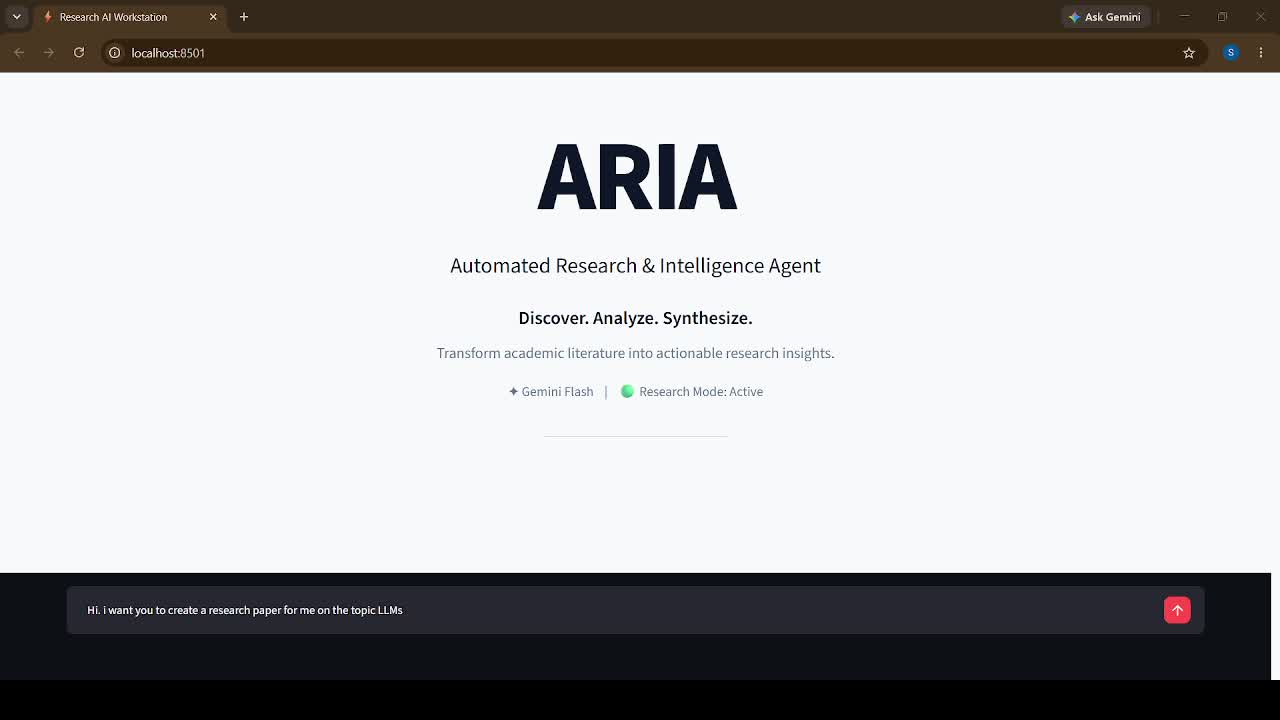
The output is not a text blob. The paper is generated as LaTeX with proper sections and mathematical formulations, compiled with Tectonic and delivered as a downloadable PDF from a Streamlit chat interface, with session memory kept by LangGraph so the conversation can continue.
03
How it was built
The code is split by responsibility: the agent graph and tool orchestration, the arXiv client, the PDF reader that prepares text for analysis, the LaTeX and PDF builder, and the Streamlit front end. Dependencies are managed with uv and the project runs on Python 3.11 or newer.
The README is explicit that generated papers must be reviewed and cited properly before any academic use. The roadmap includes a vector database, research knowledge graphs and IEEE and ACM formatting.
04
The result
Topic in, finished paper out: a working research assistant, shared publicly on LinkedIn with the source open on GitHub.
05
Tech stack
LangGraph
LangChain
Gemini 2.5 Flash
arXiv API
PyPDF2
LaTeX
Tectonic
Streamlit
How it works
1DiscoverSearches arXiv for recent papers on a topic and returns metadata and PDF links
2AnalyseDownloads the PDFs, extracts the text and summarises findings, limitations and future work
3IdeateIdentifies research gaps and proposes directions that are not yet covered
4WriteDrafts a complete paper: abstract, introduction, literature review, methodology, results and references
5DeliverCompiles the LaTeX with Tectonic and offers the PDF for download