The problem
A credit card bill mixes fees, interest and GST in a format few people read line by line, and the rules that limit those charges sit in RBI circulars. Most people either pay or give up, even when a charge looks wrong.
Shinchan Online Hackathon 2026, Rank 7
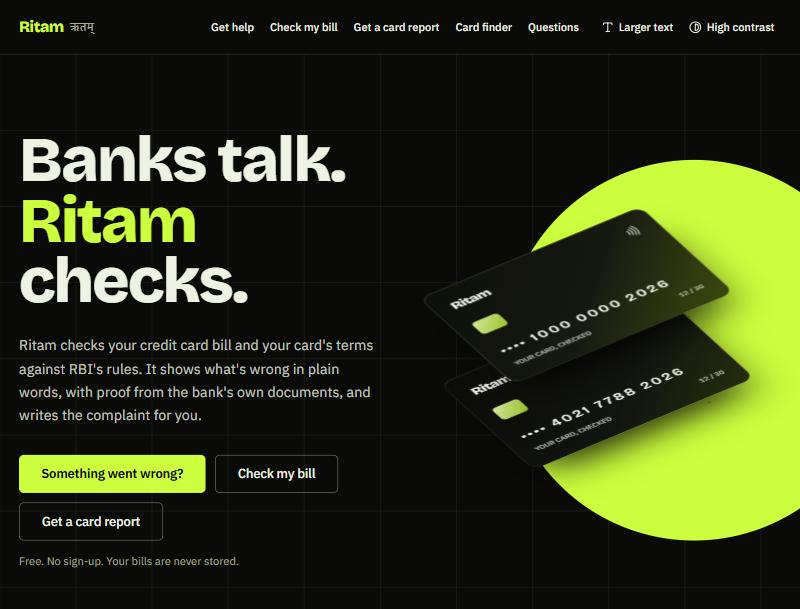
Banks talk. Ritam checks. It reads a credit card statement, flags the charges that break RBI rules, and turns each finding into a complaint letter that cites the rule.
Rank 7Shinchan Hackathon
240+automated tests
EN + HIEnglish and Hindi
A credit card bill mixes fees, interest and GST in a format few people read line by line, and the rules that limit those charges sit in RBI circulars. Most people either pay or give up, even when a charge looks wrong.
Ritam is a full-stack banking assistant for people in India. You describe a problem or upload a statement, and it checks the bill and the card’s terms against RBI rules. It can also work out the penalty when a card is not closed on time, and compare what changed on a card between two months.
The AI is only allowed to read. It proposes facts from the document, code keeps only the facts the document confirms, and fixed rules decide what counts as a problem. Bills are not stored, and personal details are masked before any AI call.
The backend is Python with FastAPI, async SQLAlchemy and a Postgres job queue. The frontend is Next.js with React and Tailwind CSS, with listen-aloud, larger text and high contrast options. A router sends language model calls across Gemini, Groq, Mistral and OpenRouter, so the free tiers are enough.
It has 240+ automated tests with strict type checking, and CI runs on every push. The frontend is on Vercel and the API on Render.
Ritam ranked 7th at the Shinchan Online Hackathon 2026, built within the 24-hour window and now live for anyone to try. The README is plain about its limits: it reports possible problems, not verdicts, it is not financial advice, and its bill test set is mostly synthetic.